How Much Pressure Can a Quick-Turn Fitting Take? Ratings, Series and Specs
Published:
“How many bar can this fitting hold?” is the right first question when routing any line beyond plain workshop air. Here is how pressure ratings work on quick-turn (screw-tightened) and push-in fittings, with the numbers from AFD’s general-purpose series.
Working pressure vs proof pressure
A fitting has two distinct numbers: the working pressure it can hold continuously, and the proof (burst-margin) pressure it survives in testing. The PL-series universal fittings, for example, are rated 0.1–1.0 MPa working with a 1.2 MPa proof — always design to the first number and leave the second as margin, never as operating headroom.
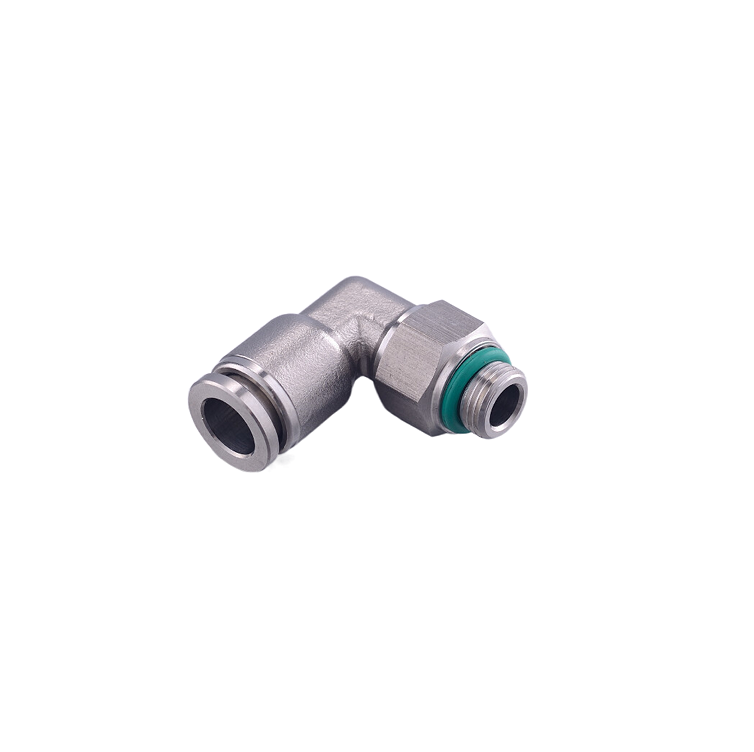
PL-series example (L-type swivel stud elbow)
| Body | Nickel-plated brass, black or grey plastic cap |
|---|---|
| Rotation | 360° swivel on the stud |
| Threads | R 1/8–R 1/2, G, NPT; metric M5–M22 |
| Tube OD | 3, 4, 6, 8, 10, 12, 16 mm (odd sizes φ5/7/9/11 on request) |
| Fluids | Vacuum and compressed air |
| Working pressure | 0.1–1.0 MPa |
| Proof pressure | 1.2 MPa |
| Temperature | −5 °C to +60 °C |
| Tubes | PU or nylon |
What the collet is made of matters
The gripping collet is the stress member of any push-in fitting. Stainless collets keep their spring over years of pressurisation cycles — a fatigued collet lets the tube walk out under pressure spikes, which is why reputable series specify stainless grab rings.
Thread designations on the spec sheet
- M — metric parallel, sealed by O-ring or washer
- R — British taper pipe, 55°
- G — British parallel pipe, 55°
- NPT — American taper pipe, 60°
Metric studs are written OD×pitch (M8×1.25, commonly shortened to M8); available tube sides φ4–φ12 on metric series.
If your circuit runs above 1.0 MPa — hydraulics-adjacent air, CO₂ or process gases — say so at enquiry time: AFD Pneumatic offers high-pressure series in brass and stainless, and will confirm the rating in writing against your media and temperature.